Saturday, 17 August 2013

Kutcher and Jobs. The Comparison Continues.

Ashton Kutcher, who plays Steve Jobs in the movie "Jobs" has started to eerily look, sound and talk more like Steve Jobs.  I don't know whether it is part of his act while he's trying to promote the movie but just as Steve Jobs had his Stanford University Commencement Speech moment back in 2005, Ashton Kutcher had his while accepting an award at the Teen Choice Awards earlier this week.

It may seem bizarre to compare the two speeches but listen to Kutcher and you start to see the similarities (click here to see the video).  
Kutcher at the Teen Choice Awards.
Image: newsday.com

While at Stanford, Jobs spoke to university students who were graduating from one of the world's premier educational institutions.  In his speech, he mentioned three stories from his life.  The first was about connecting the dots where he talks about destiny. The second story was about love and loss.  He spoke about how he got fired from Apple when he thought he was the peak of his career, how he went on to found NeXT and then Pixar.  He spoke of perseverance and about sticking it out for the long term battle.  The third story Jobs spoke about was death.  Here he spoke about living each day as if it was your last and what his bout with cancer had taught him at the time.

Ashton Kutcher in his speech was addressing teenagers at an awards ceremony and decided to lecture them on life lessons he had learned.  Again, like Jobs, he had three stories.  The first is about opportunity.  Kutcher speaks of the stepping stones to getting where he did by jobs that may have appeared dead end jobs.  He talks about never quitting his job until he had his next job.  The second is about being sexy.  His definition of the sexiest thing in the entire world is about smart, thoughtful, generous.  He goes onto to say that everything else is "crap."  The third story is based on what he learned while making the Jobs movie.  He said it is about setting your own boundaries and not necessarily accepting the status quo.  It is about building your life, not living one. (Update: a clip of Jobs that Kutcher referenced can be found here).

This speech may have been staged given that Kutcher is in full flow with the promotion of the movie but it's re-assuring to see nonetheless a positive message made out to kids who are impressionable.  Just as I know I tend to watch Steve Jobs giving his speech at Stanford every once in a while, Kutcher's viral acceptance speech may have the same appeal to teenagers who are looking for direction.

Well done Ashton and hope you've managed to guide some people to the right side of the road.

P.S. If you've never heard Jobs give his speech at Stanford, you can watch it at this link or read the transcript at this link.


Saturday, 20 July 2013

Speaking with a Clear Conscience

"Trayvon Martin could have been me 35 years ago." - President Obama

I must admit I wasn't one of those that was following the George Zimmerman-Trayvon Martin case or reacted when a verdict was reached because all too often the media tends to sensationalize matters.  Having lived in the United States when the O.J. Simpson trial happened in the 1990's, I've seen just the real issues can get missed out and how the media circus takes over.

In the Zimmerman-Martin case though, the media was clearing looking for a reaction from President Obama the moment a verdict was reached because this was probably the first landmark case related to race that has happened while he was President.  We've been used to seeing stalwarts like Rev. Jessie Jackson speak up over the decades but having a sitting President of African-American descent meant the stakes were higher this time.

Image: www.praisedc.com


President Obama though took this case in his own stride and let the hype die down a bit before making his own heartfelt comments on the case.  As we've seen on more than one occasion, President Obama hasn't looked to sensationalize matters when the iron has hot but has always let the dust settle before talking.  His approach has been pragmatic, often frustrating those around him.

I do appreciate the fact that when President Obama has spoken, it's been with a clear conscience.  He spoke yesterday with a handwritten statement where he spoke from his heart.  The impact of this is always greater and instead of politicizing an issue further as many others would, he put things in perspective.  I've not taken sides in the American political arena but appreciate it when a person in a position such as that of President Obama where to draw the line as to what is politics and what isn't.

If you haven't read or heard President Obama's speech, the following paragraph from the New York Times summarizes what he said in a nutshell.

But in the most expansive remarks he has made about race since becoming president, Mr. Obama offered three examples of the humiliations borne by young black men in America: being followed while shopping in a department store, hearing the click of car doors locking as they cross a street, or watching as women clutch their purses nervously when they step onto an elevator. The first two experiences, he said, had happened to him. (source: New York Times).


Thursday, 18 July 2013

Taking Pictures & Videos in the UAE - A Cultural Issue

There's been an uproar in the UAE in the last few days with regards an incident where an Emirati man was recorded on video attacking another driver.  The Emirati says he attacked the man because he drove after a minor accident and once he caught up to him, he did what he did and a lot of us saw it on YouTube with a video recorded by another motorist.

The motorist as it turns out has now been arrested for recording a video without knowledge of the Emirati man and this is against the law in the UAE.  The contention of Dubai Police is that the motorist who recorded the video shouldn't have shared it publicly, rather he should have given it directly to the police.

In this post, I'm not debate the merits of the case or passing any judgement here but rather talking about sensitivities that exist in this region with regards taking pictures or videos.  I've managed a photo studio and a business that distributed minilab equipment to other studios so I've been how culturally sensitive the topic of photo and video can be.
Image: el3mentsofwellness.com

In the studio business that I used to manage, we used to do a lot of event photography and video recording.  When it came to doing events which were women-only, we had to ensure we used female photographers.  We also used women to do the editing and post processing of videos and pictures.  Even in our own studio where we had our own minilabs installed, we had to ensure that any screens, monitors or printers we had were positioned in such a way that no one other than our staff could view it.

Even at events where there were men or men and women, we've had to be sensitive as to which pictures were being taken as someone people are clearly not comfortable being photographed.  We have the respect the culture we're in and why this can become an issue.

For the minilab equiment business I ran, I remember we contemplated distributing photo kiosks that could be used within retail establishments or other public areas.  The problem that we could never get our head around was how do we supply this and yet protect the privacy of the person who is using the kiosk.  It is very easy for a passerby to see what was on the screen of the kiosk or what was being printed.  In short, we decided not to actively pursue this business.

I can understand why the laws state that taking pictures or videos without permission is illegal if seen from a cultural stand point.  There are though a whole host of cases where the validity of this law may be challenged as in this case.  We've all got our own opinions as to whether this is valid and while I'm not saying whether I support it or not, I just think we need to see both sides of the argument before passing judgement.

In case you're not aware of this case, this post from Alex Malouf nicely explains some of the background to this incident. 

Saturday, 13 July 2013

Malala Yousufzai: Inspiring, Courageous, Victortorious.

I remember that there was a boy in our school who was asked by a journalist, “Why are the Taliban against education?” He answered very simply. By pointing to his book he said, “A Talib doesn't know what is written inside this book.” - Malala Yousufzai

A weekend day in Ramadan can be very slow when you're living in a part of the world when most people observe the fast.  Often you end up watching TV, reading or getting your spring cleaning done (in the summer).

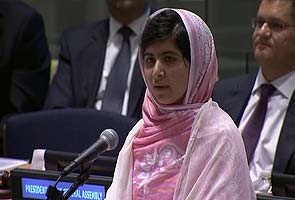
So on a lazy Friday afternoon, I was flipping channels on my TV when Malala Yousufzai was about to address the youth wing of the United Nations.  Sitting in to listen to her was the United Nations Secretary-General, Ban Ki-Moon and ex-British Prime Minister, Gordon Brown who is currently a UN Special Envoy for Education.
Malala Yousufzai at the UN, wearing a shawl belong to Benazir Bhutto.
Image: ndtv.com
Little did I know how much I would be moved by this sixteen year-old who had just nine months survived a gun shut to her head fired by a Talib.  The maturity with which she addressed the audience would put most grown people to shame but after surviving an attack the way Malala did, she's probably reflected and pondered on what the value of her life is and what she can do with it.

There were so many great quotes from Malala's speech and I'd highly recommend you watch the video on YouTube if you can or read the speech in full.

Mother Theresa and Nelson Mandela are the humanitarians that this generation knows best but it is inspiring to know that there is another generation of humanitarians emerging.  Malala is just one shining example who managed to give a speech that tore down all the boundaries across religion, culture and other biases we keep in our minds.  No doubt she will do more than just give speeches in the future and she may be the reason we see more great humanitarians emerge.

Ramadan is a month of reflection.  No matter what your religion is, hearing words like this from Malala, makes you realize how petty we can be and how much more we could be doing.  If a sixteen year old girl from the Swat Valley in Pakistan can survive a gun shot and then come back nine months later to speak of what she can do for others who don't have access to education, why can't we make a change?

I was fortunate enough to watch Malala speak yesterday while my seven year old daughter sat at my side.  My daughter had a moment when the speech ended when she realized how lucky she is but how many more aren't quite as fortunate as her.

Malala, my blessings are with you in your cause and thank you for showing me what more we can be doing.

I've extracted below a few passages from Malala's speech yesterday but highly recommend you read or listen to the full speech.

Dear Friends, on the 9th of October 2012, the Taliban shot me on the left side of my forehead. They shot my friends too. They thought that the bullets would silence us. But they failed. And then, out of that silence came, thousands of voices. The terrorists thought that they would change our aims and stop our ambitions but nothing changed in my life except this: Weakness, fear and hopelessness died. Strength, power and courage was born.  I am the same Malala. My ambitions are the same. My hopes are the same. My dreams are the same.
Dear sisters and brothers, I am not against anyone. Neither am I here to speak in terms of personal revenge against the Taliban or any other terrorists group. I am here to speak up for the right of education of every child. I want education for the sons and the daughters of all the extremists especially the Taliban.
I do not even hate the Talib who shot me. Even if there is a gun in my hand and he stands in front of me. I would not shoot him. This is the compassion that I have learnt from Muhammad-the prophet of mercy, Jesus christ and Lord Buddha. This is the legacy of change that I have inherited from Martin Luther King, Nelson Mandela and Muhammad Ali Jinnah. This is the philosophy of non-violence that I have learnt from Gandhi Jee, Bacha Khan and Mother Teresa. And this is the forgiveness that I have learnt from my mother and father. This is what my soul is telling me, be peaceful and love everyone.
Dear sisters and brothers, we realise the importance of light when we see darkness. We realise the importance of our voice when we are silenced. In the same way, when we were in Swat, the north of Pakistan, we realised the importance of pens and books when we saw the guns.

Sunday, 16 June 2013

Bill Gates: The Quintessential Humanitarian

As anyone who knows me, I've been an Apple fanboy and even on my blog, I've often written and referred to the legacy of Steve Jobs.  The man was no doubt brilliant and the comparison has often been made between Jobs and Bill Gates.

The more time I've spent thinking about it though, my respect for Gates has grown.  Steve Jobs may have re-invented Apple and made us re-think how businesses work but Bill Gates was a revolutionary in that he brought personal computing mainstream before deciding he wanted to do more by making the world a better place for generations more.
Bill and Melinda Gates

Back in May of this year, I was watching Bill Gates interview on 60 Minutes with Charlie Rose where Gates spoke with humility about what he was doing to help those in need.  Gates, together with his wife Melinda have worked tirelessly to focus on issues like poverty, healthcare in lesser developed countries and education (watch is TED talk on education also from May of this year).  With all the resources at his fingertips though, Gates has remained fairly hands on in his quest to change the world.

Even the letter Bill and Melinda Gates on their foundation's website acknowledges the entrepreneurial flair they've instilled in their foundation.  They start by saying "Our friend and co-trustee Warren Buffett once gave us some great advice about philanthropy: “Don’t just go for safe projects,” he said. “Take on the really tough problems.”"

They continue on by saying " Some of the projects we fund will fail. We not only accept that, we expect it—because we think an essential role of philanthropy is to make bets on promising solutions that governments and businesses can’t afford to make. As we learn which bets pay off, we have to adjust our strategies and share the results so everyone can benefit."

If Gates succeeds in his mission of eradicating malaria and polio by ensuring the world's poorest have  access to proper sanitation facilities, he would have done more for humanity than could have ever been envisioned when he was dropping out of Harvard to co-found Microsoft.

I'm not saying that everyone can expect to do what Bill Gates has done in his lifetime but if you do wake up tomorrow wondering what you can do in your life, I hope you will take away a nugget of inspiration from what Bill Gates has set out to do.

Saturday, 20 April 2013

President Obama & Sunil Tripathi: Social Media Lessons

Following the drama we've seen in Boston this week, the role and power of social media to inform and misinform has once again been highlighted.  I had written about this earlier in the week (Lessons from Boston and the Dubai Tremors) but it was refreshing to see President Obama address the issue head on in his comments following the capture of Suspect #2.
President Obama at the inter-faith service in Boston.
Image: www.nydailynews.com
He said as follows:
In this age of instant reporting and tweets and blogs, there's a temptation to latch on to any bit of information, sometimes to jump to conclusions. But when a tragedy like this happens, with public safety at risk and the stakes so high, it's important that we do this right. That's why we have investigations. That's why we relentlessly gather the facts. That's why we have courts. And that's why we take care not to rush to judgment -- not about the motivations of these individuals; certainly not about entire groups of people.
(To read his full statement, click here).

It is very easy to jump to conclusions and fuel a rumour mill with misinformation.  I know I was guilty of this earlier this week when I started mentioning to people Suspect #2 was Sunil Tripathi.  I got this information from what I thought were reliable social media feeds and was gutted to find out an innocent man who has been missing was being wrongly mistaken as a bomber.  You have to feel for his family in such times and when I saw the video his family posted on YouTube for his return, you feel even worse.  If you haven't seen the video, click on it below.


Some sections of the media got it right. They held back in giving names, ethnic backgrounds and further details of the suspects when it seemed everyone was talking about it.  I now understand and respect those sections of the media that did.  It is not only about first to market but about being respectful about the fact that you are dealing with people, families, emotions and reputations.

There is a Facebook page for Sunil Tripathi also and if you can, please do follow it (http://www.facebook.com/pages/Help-Us-Find-Sunil-Tripathi/403275636436466?fref=ts)

I don't know Sunil Tripathi but hope his family has a sense of closure one way or another.  I'm sure the video only shows glimpses of how they've missed him and how important he has been to them.  We've seen the role of people in helping capture the two Boston bombing suspects, I just hope the same people can also help bring Sunil (or Sunny as his family calls him) home.

Update (21 April, 2013): Sunny Tripathi's siblings spoke to a media outlet in an interview shortly after their brother's name was cleared.  Have a look at that link here.  The Twitter account setup to post updates is @findingsunny.

Update (27 April, 2013): Sunil Tripathi's body was recovered in the waters off Providence, Rhode Island.  My condolences are with the family during their time of grief and hope his soul rests in peace.  Losing a loved one is never easy but not having any closure can be more difficult I'd imagine.  RIP Sunny.

Tuesday, 16 April 2013

Lessons from Boston and the Dubai Tremors

In less than twenty-four hours, two major events have stood out on my social media feed: the Boston Marathon tragedy and the tremors we felt here in Dubai.

Both impacted me.  I went to university in Boston and lived there for three wonderful years and I loved the spirit of the city.  In the case of the tremors we felt in Dubai today, I like most of the city felt the ground shake and there is natural concern that you have for the safety of your dear ones after events like this.
Image: http://godhungry.org

In both cases, I saw Twitter and Facebook explode.  In both cases, I saw concern, sorrow and fear.  

In both cases though, I saw people intentionally or unintentionally take advantage of the situation or jump to dangerous conclusions on social media.  

For those who took advantage of the situation, shame on you.  This is not a time to promote your brand or product with earth-shattering offers.  

For those who started jumping to conclusions that weren't fully thought out, remember, just because you can think it, doesn't mean you need to type it.  If you are going to type it, think about it and ask yourself would feel comfortable saying what you're about to type in front of a larger gathering.  If you think you wouldn't be comfortable talking about it in a larger forum, then don't type it.

Social media is powerful.  Understanding the power it holds and applying it aptly though is something many of us tend to forget when we're excited.  Take a deep breath, think through what you're doing and remember, it's not always about being first to express your thoughts but about being thoughtful in what you express.